For the last few years, I was part of a team called Microsoft Language Excellence. Now, I am part of a consultant group called ExcellenceTerm. To some, including excellence in one’s name might be presumptuous, even arrogant. To me, it is part of the vision.
Let’s look into the etymology. Excellence comes from Latin excellere which means to distinguish oneself or to raise oneself above. If we look up ‘to excel’ in OneLook© Dictionary Search, we find that most dictionaries define it as to do better than, to surpass, to be outstanding, to have a particular talent in something, to do better than a given standard, etc.
Is there something wrong with doing better than a particular standard? Or with being outstanding? I believe not in our Western culture. In a competitive environment, such as the Microsoft culture, there certainly is a positive connotation with the fact that you think you can surpass someone else. My vision for Microsoft Language Excellence was always to be the best resource for terminology management within the company. I believe we fulfilled that vision during most of the existence of Language Excellence.

 ExcellenceTerm is part of TermNet, the International Network of Terminology. TermNet was founded in 1988 based “on the initiative of UNESCO, with the aim to establish a network for co-operation in the field of terminology.” ExcellenceTerm is a small group of terminology consultants who are working on various projects, including a certification program for terminologists called the ECQA Certified Terminology Manager.
Economic ups-and-downs aside, we all have to be motivated in our professional lives in order to keep our jobs, make a living, not burn out, etc. Striving for excellence—not achieving perfection—is for me a healthy way to add value and enjoy what we are doing.

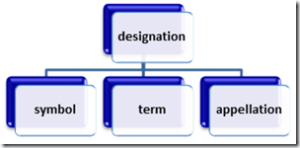 Terms represent generic concepts. They are the parent concept or superordinate to other concepts. The concept called “operating system” in English has many different subordinate concepts, e.g. Windows, Linux, or Mac OS. Many times generic concepts have native-language equivalents in other languages. Of course, a particular language may borrow a term from another language, a direct loan. But that should be a deliberate term formation method and it is just one of them, as discussed in
  Once again, I find ISO 704 very helpful: “Technically, appellations are not translated but remain in their original language. However, an individual concept may have an appellation in different languages.” Good examples are international organizations which tend to have appellations in all languages of the member states, such as the European Union, die Europäische Union, or l’Union européenne.
 There are actually two concepts hidden behind this name: